Grave of the Fireflies Ending Explained and Full Review
Takahata shows you the deaths first, then makes you decide who to blame. Our Grave of the Fireflies review: the ending, the aunt, the 100 percent score.
Grave of the Fireflies (1988)
Key facts
- Title
- Grave of the Fireflies
- Year
- 1988
- Released
- April 16, 1988
- Director
- Isao Takahata
- Cast
- Tsutomu Tatsumi, Ayano Shiraishi, Yoshiko Shinohara
- Genres
- Animation, Drama, War
- Studio
- Studio Ghibli
- Country
- Japan
- Language
- Japanese
- Certification
- NR
- Budget
- $3,700,000
- Box office
- $4,979,495
- Our rating
- 8.45/10
- Our verdict
- Takahata shows you the deaths first, then makes you decide who to blame. Our Grave of the Fireflies review: the ending, the aunt, the 100 percent score.
- Reviewed on
- November 9, 2026
- Reviewed by
- The Editor
Is Grave of the Fireflies worth watching?
Takahata shows you the deaths first, then makes you decide who to blame (our rating: 8.45/10).
My review
# Grave of the Fireflies Ending Explained and Full Review
The Grave of the Fireflies ending explained in one line: Seita dies at the train station on September 21, 1945, about a month after Setsuko starves to death in the shelter on August 22, and the film then returns both children to the hill above the city as ghosts who keep watching a Japan they never got to live in. Isao Takahata's 1988 Studio Ghibli tragedy sits at 8.45/10 on TMDB from 6,915 votes and 8.5/10 on IMDb from roughly 400,000 ratings, and Rotten Tomatoes holds it at 100 percent from 50 critics, all checked October 27, 2026. Nothing about that record suggests a recap. It suggests an argument, and this review is about the argument.
Spoiler-free verdict: Fourteen-year-old Seita and his four-year-old sister Setsuko lose their mother in the June 1945 Kobe air raid, lose their aunt's household, and lose the war they were never part of. Takahata refuses every easy consolation and the animation stays tender anyway. Rated 8.45 on TMDB. Full spoilers below.
What Grave of the Fireflies is about
Takahata adapted the film from Akiyuki Nosaka's story of the same name, and he sets the frame before the story starts. The opening images are of Seita dead at the station, and a tin of ashes in a stranger's hand, so the audience is told the outcome in the first minutes and asked to watch the machinery that produces it.
The story itself begins on June 5, 1945, when B-29s hit Kobe. Seita's mother is caught in the raid and dies of her burns; his father is a naval lieutenant away with the fleet. Seita, fourteen, and Setsuko, four, move into their aunt's house in Nishinomiya. It starts well. It stops when the rice runs short, when Seita neither works nor attends school, and when he plays the accordion to keep Setsuko amused and is told that the neighbours will talk. The aunt calls him a plague god, and Seita takes his sister to an abandoned hillside shelter with the 7,000 yen their mother had saved.
The shelter is the middle hour of the film: a tin roof, a firefly colony, river bathing, and a slow arithmetic of food. Seita sells his mother's kimono for rice, then for money, then for nothing. Setsuko's stomach swells, her hair thins, and the film never turns any of it into a montage.
Cast and performances
Both children are voiced with an ordinary, un-performed quality that the film depends on. Tsutomu Tatsumi plays Seita as a boy performing competence he does not have, and Ayano Shiraishi gives Setsuko the delighted laugh lines that make the hunger legible without ever making her a symbol. Yoshiko Shinohara voices the mother, who is on screen for minutes and is remembered for one gesture, and Akemi Yamaguchi plays the aunt as a woman doing wartime maths rather than as a villain. Masayo Sakai and Kazumi Nozaki fill out the household and the town, and the smallness of the cast keeps the story on one family.
What works
The refusal. Takahata said in interviews collected for the film that he did not consider it an anti-war picture, and the structure backs him up: there is no rally, no speech, no villain to defeat, only a household budget that stops adding up. Critics have graded it that way for decades. Glenn Kenny wrote in the New York Times that it is "one of the most startling and moving animated films ever", a review dated January 2019, thirty years after the release, which is the clearest evidence that the film's argument has held.
The detail. Takahata was nine in an air raid on Okayama and wanted the rain of fire that survivors described, so the Kobe sequence is built from observation rather than spectacle, right down to the bombs that fall like paper lanterns. Michio Mamiya's score stays out of the way, and the animation of ordinary things, a tin of candy, a fruit drop, a firefly lifted at night, does the emotional accounting.
What doesn't
The very quality that makes it permanent also makes it hard to rewatch, and not every critic has forgiven that. Mike Massie at Gone With the Twins graded it 6/10 and called it historic, tragic and sad in the same breath, an admiring review that still keeps its distance, which is the honest objection to a film built on cumulative dread rather than incident.
The aunt is the other fault line. Read one way she is wartime scarcity given a face; read another she is the adult failure the film is indicting, and the film gives you no narrator to settle the question. Her complaints are staged as household accounting rather than as cruelty, which keeps the blame genuinely open instead of merely ambiguous.
What audiences say
TMDB has the film at 8.45/10 from 6,915 votes, IMDb at 8.5/10 from around 400,000 ratings, and Rotten Tomatoes at 100 percent from 50 critic reviews against a 95 percent audience score from more than 10,000 ratings, checked October 27, 2026. The RT critics consensus calls it an achingly sad anti-war film and one of Studio Ghibli's most profoundly beautiful, haunting works, which is the rare consensus sentence that argues with the director and gets the film right anyway. A five point gap between 100 percent critics and 95 percent audiences is as close to unanimity as an aggregate gets, and it explains why the film keeps reappearing on animation lists long after its release stopped being an event.
Where to watch Grave of the Fireflies
In the United States, TMDB's watch guide lists Netflix and the ad-supported Netflix tier as subscription options, with Amazon Video for rental and purchase. In India it lists Netflix, checked October 27, 2026. Availability moves by region and language, so confirm on your device before you start.
Grave of the Fireflies ending explained
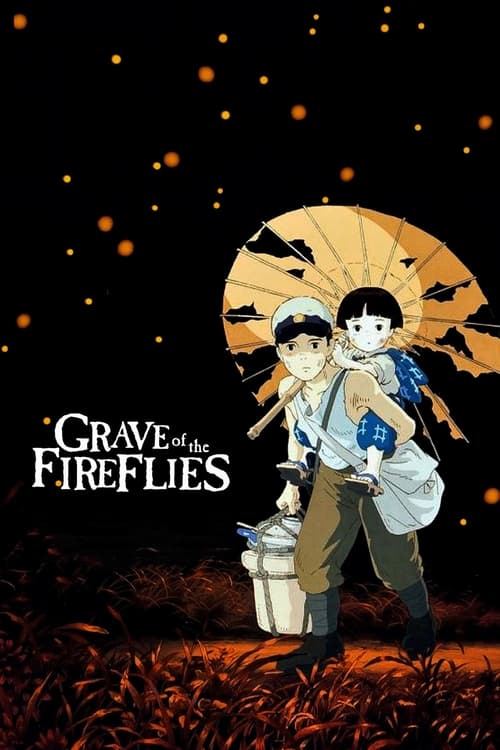
!Grave of the Fireflies ending explained: Seita and Setsuko together in the official poster
The ending is decided by two dates. Setsuko dies on August 22, 1945, in the shelter, after the last of the food and the last of Seita's money are gone, and the film holds on the moment the tin of candy she has been scraping empties. Seita buries her and the shelter's fireflies. He then takes the ashes and moves to the station, where people still are, and dies there on September 21, 1945, a month later. A man's hand closes the tin. The camera lifts.
Then comes the sequence the title has been earning. The siblings appear as ghosts, together and calm, and the film walks them back to the shelter they shared, where Setsuko plays and Seita watches a modern Japanese city below them. The coda is not a punishment and it is not a rescue. It is the film saying that the two of them are still there, still looking, in a country that carried on without them.
The Grave of the Fireflies ending explained without the euphemism is that the war does not kill them in an air raid and does not kill them with a soldier. It kills them with rent, with rice, with a relative's reasonable arithmetic and a brother's pride, over five weeks of small refusals. Seita is not innocent in it, since leaving his aunt's house was his choice, and the aunt is not monstrous in it, since she was feeding a household from a shrinking pot. Takahata's point, the one he refused to call anti-war, is that both of those things are true at once and that the children die in the gap between them.
The verdict
Grave of the Fireflies is the rare film that gets more, not less, precise as the decades pass, because the thing it documents, a household coming apart under scarcity, keeps finding new audiences. The 8.45 on TMDB from 6,915 votes, the 8.5 on IMDb from about 400,000 ratings, and the 100 percent Tomatometer from 50 critics say the same thing from three directions. Watch it once for the story and once, as Takahata intended, for what the first frame already told you. Our animation coverage and the full review index carry the rest of what we have covered, and for another film that treats death as ordinary business, see our Masaan review.
Rating: 8.45/10 (TMDB 8.45/10 from 6,915 votes, IMDb 8.5/10 from about 400,000 ratings, Rotten Tomatoes 100% critics from 50 reviews and 95% audience from 10,000+ ratings; checked October 27, 2026)
Movie info
- Title
- Grave of the Fireflies
- Year
- 1988
- Director
- Isao Takahata
- Cast
- Tsutomu Tatsumi, Ayano Shiraishi, Yoshiko Shinohara, Akemi Yamaguchi, Masayo Sakai, Kazumi Nozaki
- More data
- View on TMDB
Related reviews
More titles in a similar vein, from our own archive.
Light of the World Review: Beautiful Animation, Blunt Lesson
Watch it if the family will sit still. The animation is lovely, the story is the Gospel, and the film is never subtle. Rotten Tomatoes has it at 80 percent.
13 Hours Review: Michael Bay's Benghazi Film Is His Most Restrained War Drama
Critics were split, audiences were not. Our 13 Hours review of Michael Bay's Benghazi thriller: the RT split, cast, and where to watch.
Condor Review: The Smart CIA Thriller Nobody Could Find
A smartly expanded Three Days of the Condor with Max Irons, killed by its own channel. Our Condor review: the cast, the scores, and where to find it.