Tumbbad Ending Explained and Full Movie Review
Tumbbad ending explained: what Hastar's gold costs Vinayak, why Pandurang burns the body, and where to watch the 2018 fable.
Tumbbad (2018)
Key facts
- Title
- Tumbbad
- Year
- 2018
- Released
- October 12, 2018
- Director
- Rahi Anil Barve
- Cast
- Sohum Shah, Mohammad Samad, Harsh K.
- Genres
- Fantasy, Horror
- Studio
- Filmgate Films, Film i Väst, Sohum Shah FIlms, Colour Yellow Productions, Eros International
- Country
- India, Sweden
- Language
- English, Hindi, Marathi
- Certification
- NR
- Franchise
- Tumbbad Collection
- Our rating
- 7.6/10
- Our verdict
- Tumbbad ending explained: what Hastar's gold costs Vinayak, why Pandurang burns the body, and where to watch the 2018 fable.
- Reviewed on
- November 9, 2026
- Reviewed by
- The Editor
Is Tumbbad worth watching?
Tumbbad ending explained: what Hastar's gold costs Vinayak, why Pandurang burns the body, and where to watch the 2018 fable (our rating: 7.6/10).
My review
# Tumbbad Ending Explained and Full Movie Review
The Tumbbad ending explained in one line: Vinayak trades three generations for gold, and his son refuses the trade, which is why the curse finally stops. The 2018 film sits at 7.6/10 on TMDB from 373 votes and holds 86% on Rotten Tomatoes from 28 reviews, so the Tumbbad movie review writes itself. What follows is the full story, the Hastar myth behind it, and where to watch it.
Spoiler-free verdict: A folklore horror fable about greed that earns its reputation. Sohum Shah plays Vinayak Rao across decades, the production design and rain-soaked cinematography are the reason Indian horror keeps getting compared to it, and the last twenty minutes turn a treasure hunt into a family warning. Rated 7.6 on TMDB. Full spoilers below.
What Tumbbad is about
Tumbbad opens with a warning delivered over a village drowning in monsoon rain, then follows Vinayak Rao, the son of a servant household cast out of a wealthy estate. Years later he comes back to the village of Tumbbad in Maharashtra, drawn by a rumour his family never let go of: gold is sealed in the courtyard of an old goddess statue, and something else guards it.
The something else is Hastar, a god nobody prays to. The film's opening narration lays out his origin: the firstborn child of the creator, handed dominion over gold and grain, then cursed by his own siblings and driven out of heaven. He lives in the statue's womb. He offers gold to anyone willing to descend, and he attacks anyone who takes more than they should.
Vinayak descends. He learns the rules, builds his own method for getting out alive, and starts shipping gold out of Tumbbad in bulk. The story runs in chapters, ending in 1947, and each chapter tightens the same idea: the gold is never free, the debt is always paid in blood, and the person paying it changes.
Is Tumbbad based on a true story
The village is real. Tumbbad is a settlement in Maharashtra, and the film was shot in and around it, which is why the mud, the courtyard and the temple steps feel documented rather than built.
Hastar is not real. The god, the curse and the rules of the courtyard were written for the film by Rahi Anil Barve with writers Adesh Prasad and Ani Gautam, working from a story Barve developed with Pushkar and Gayatri. There is no folk religion behind him, which is exactly what makes the movie unsettling: it invents a deity with the confidence of an inherited one.
The invention also solves a practical problem. Folklore horror usually inherits its rules, so an audience arrives already knowing how the creature behaves, and Tumbbad cannot rely on any of that. It has to teach you its own rules in real time, and every lesson costs Vinayak something, which keeps the exposition inside the danger instead of outside it.
Why the Tumbbad movie looks different from other Indian horror
Three craft choices carry the film.
First, the rain. Tumbbad is wet almost the entire way through, and the monsoon does the work a jump scare usually does. Sound arrives before the threat, the courtyard floods, and the gold sits in water the whole time, which turns every descent into a race against weather as much as against Hastar.
Second, the colour. The palette runs from mud brown to furnace orange, and the only thing that ever glows is the gold itself. When the film wants you to feel temptation, it does not need dialogue, it just lets the metal light up a face.
Third, the performance. Sohum Shah produced the film over roughly a decade and plays Vinayak from an eager young man to a hoarse, limping addict. Mohammad Samad, who plays the young Pandurang, gets the film's moral weight, and the scenes between father and son in the final chapter work because the boy has been watching the whole time.
Fourth, the repetition of the route itself. Each trip down follows the same beats: the rope, the bucket, the same drop taken over and over until the path reads as ritual rather than exploration. By the final chapter you have watched Vinayak perform the descent enough times that the camera no longer needs to explain the space, and the horror arrives on a familiar walk instead of an unfamiliar one. That economy is why the climax can hold two generations in one courtyard without cutting away to anything else.
It is worth saying what Tumbbad does not have: a single sustained antagonist of the slasher kind. The horror comes from appetite. If you want the same strain of Indian horror with a meaner streak, our Insidious: The Red Door review sits on the same shelf, and our Masaan review covers the other side of what Indian cinema does with mortality.
Where to watch Tumbbad
Tumbbad streams on Amazon Prime Video in India and in the United States, checked October 27, 2026 against TMDB's watch guide for the United States. The film also returned to Indian cinemas in 2024, and that re-release earned about 38 crore against an initial theatrical run of around 15.46 crore, per its Wikipedia entry, which is a rare second life for a horror film. Regional availability moves, so confirm the listing on your device before you start.
Tumbbad ending explained
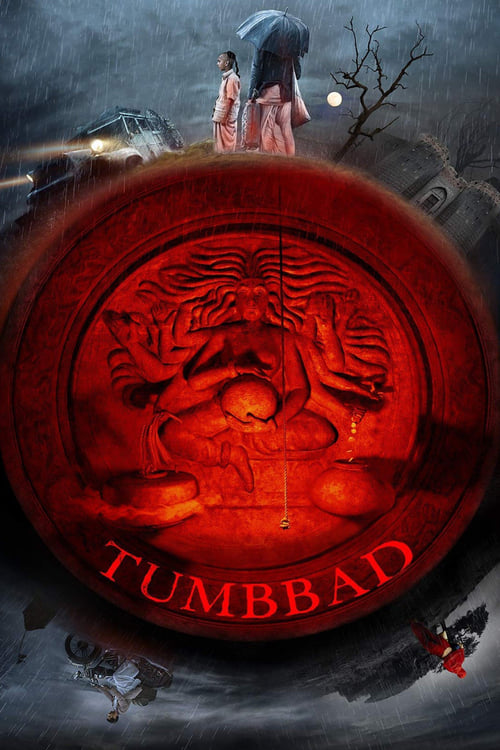
!Tumbbad ending explained: Pandurang walks away from the cursed village in the Tumbbad poster
The final chapter is set in 1947. Vinayak, old now and still hungry, brings his son Pandurang to Tumbbad to secure the gold for the next generation. He has done this before, with rules and rope and the dough doll he has used since boyhood as a decoy to keep Hastar busy while he fills his pockets.
This time the courtyard has changed. Hastar has multiplied: the god is now a swarm of copies, and the chamber crawls with them. When the swarm comes for both of them, Vinayak does the only thing left to do. He ties the dough dolls to his own body and lets every clone tear into him so that Pandurang can climb out.
Vinayak follows, burnt, half blind and cursed, exactly like the scarred old woman who once guarded the courtyard and warned him what it would cost. In the film's last beat he holds out the loincloth of gold to his son, repeating the offer his own father made. Pandurang refuses it. He tells his father to sleep, invokes Hastar's name to put him under, and then burns him where he lies. The boy walks out of Tumbbad and does not look back.
That refusal is the whole film. The curse is not broken by a spell or a temple ritual. It ends because one person in the line declines the gold, and Tumbbad's horror is that it took greed, exhaustion and a dead father to get him to that decision. The sequel in development picks up with Pandurang as the adult heir, which is the story the ending sets in motion.
The verdict
Tumbbad is a slow, wet, beautifully ugly fable that treats greed as the actual monster, and it lands. The TMDB rating of 7.6 from 373 votes matches the consensus around it, and the 86% Tomatometer from 28 reviews confirms critics saw the same film. It runs tight for something this deliberate, and the last act repays the patience. Read our full review index for more Indian cinema coverage.
Movie info
- Title
- Tumbbad
- Year
- 2018
- Director
- Rahi Anil Barve
- More data
- View on TMDB
Related reviews
More titles in a similar vein, from our own archive.
Buddy Review: The Sweetest Kids' Show With the Worst Host
A singing orange unicorn turns into a tyrant in Casper Kelly's Buddy (2026). Gross, funny and uneven. Our review, with the verdict.
Insidious: Out of the Further Review: Good Scares, Hollow Mythology
The pillow fort is genuinely scary. The mythology is not. Our Insidious: Out of the Further (2026) verdict.
Other Mommy Review: Jessica Chastain Carries a Horror Film That Falters
Chastain plays the mother and the monster, and the jump scares add up to nothing. Our Other Mommy (2026) verdict.