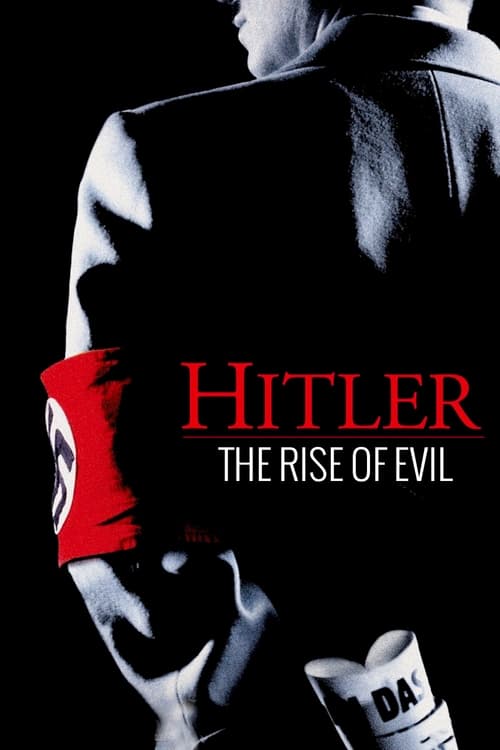
Hitler: The Rise of Evil Review: Robert Carlyle's Hitler and a Miniseries That Dodges the Worst of It
Watch it for Robert Carlyle. The 2003 CBC and CBS miniseries has a superb lead and stops before the worst of it. One critic review on Rotten Tomatoes.
Hitler: The Rise of Evil (2003)
Key facts
- Title
- Hitler: The Rise of Evil
- Year
- 2003
- Runtime
- 3h 10m
- Director
- Christian Duguay
- Cast
- Robert Carlyle, Peter O'Toole, Peter Stormare
- Genres
- Drama, War & Politics
- Our rating
- 6/10
- Our verdict
- Watch it for Robert Carlyle. The 2003 CBC and CBS miniseries has a superb lead and stops before the worst of it. One critic review on Rotten Tomatoes.
- Reviewed on
- October 21, 2026
- Reviewed by
- The Editor
Is Hitler: The Rise of Evil worth watching?
Watch it for Robert Carlyle (our rating: 6/10).
My review
Yes, Hitler: The Rise of Evil is worth watching for Robert Carlyle and for little else in the production. The 2003 CBC and CBS miniseries, directed by Christian Duguay and running 190 minutes across two parts as Rotten Tomatoes lists it, has one performance of a leader that carries most of that running time and a script that treats the rest of Germany as scenery. The critical record is thin. Rotten Tomatoes carries a single critic review and no Tomatometer percentage, Letterboxd's member average is 3.26 from 12,642 ratings, and Metacritic does not list the title. All checked on October 22, 2026.
Spoiler-free verdict: Watch it for Carlyle, who is extraordinary, and for Peter O'Toole as Hindenburg. Skip it if you want the worst of Hitler on screen, because the miniseries stops before the worst and then narrates the rest. A two-part, 190-minute CBC and CBS miniseries from 2003, with a single critic review and no Tomatometer percentage on Rotten Tomatoes and a 3.26 member average on Letterboxd, checked on October 22, 2026. You need no plot summary before pressing play.
What Hitler: The Rise of Evil is about
A biographical miniseries, made by Alliance Atlantis for CBC in Canada and CBS in the United States. It premiered on CBC and CBS on May 18 and 20, 2003, a Sunday and a Tuesday at nine at night, the schedule Variety's credits block records. Christian Duguay directs, John Pielmeier and G. Ross Parker wrote it, Robert Carlyle plays Hitler, and Peter O'Toole plays the President Paul von Hindenburg.
The first part covers the years before power. Hitler is refused by the Academy of Fine Arts in Vienna, comes home from the First World War with an Iron Cross and a blind right eye, and in Munich is sent by his army handlers to report on the city's political parties. Anton Drexler recruits him to write speeches for the German Workers' Party. Ernst Hanfstaengl (Liev Schreiber), the wealthy art publisher, buys him a new image and a symbol and puts him in front of the city's real power, among them Hermann Göring and Ernst Röhm, the organiser of the SA.
The second part covers the climb. Hitler forces Drexler out in 1921, survives the Beer Hall Putsch of November 1923 and the nine months in Landsberg prison where he writes Mein Kampf, and then does the work nobody expected of him, which is winning elections. By 1932 his party is the largest in the Reichstag. January 1933 makes him Chancellor, the Reichstag fire hands him dictatorial powers, the journalist Fritz Gerlich (Matthew Modine) is arrested and sent to a concentration camp, and after Hindenburg dies in August 1934 Hitler takes the presidency as well.
Cast and performances
Carlyle carries it. Variety's Michael Speier wrote that Carlyle "is the whole show, unflinching in his intensity. He's in almost every frame, and he transforms from a ragamuffin fringe feeder with bad clothes and a mussy exterior to a bug-eyed, razor-sharp robot with every hair in place and every button fastened." Speier's reservation was the pitch itself: "It's overboard as much as it's passionate."
The rest of the cast is good work in a thin script. O'Toole's Hindenburg is the other performance people remember, dry and unimpressed. Schreiber's Ernst Hanfstaengl is the conscience of the first half, a man who helps a monster and then loses his wife and his curiosity to him. Variety noticed the arc, with Schreiber enthusiastic at first and then losing both his curiosity and his wife to the cause, and the subplot's best shot a marriage falling apart. Modine is solid as Gerlich, the journalist who keeps writing against Hitler and keeps going to prison. Julianna Margulies plays Helene Hanfstaengl. Jena Malone plays Geli Raubal, whose suicide the miniseries treats as the hinge of Hitler's private life.
Carlyle told CBS News' Rome Neal in May 2003 that the role was unlike anything he had taken, because the man existed. Neal's report has him saying that playing the character "was a challenge because he has never played a person that had existed in real life." On the ethics of it, he said "the movie does not take a sympathetic look at Hitler, but it does try to portray the events of the dictator's life accurately."
The miniseries was nominated for seven Emmy Awards and won two, for art direction and for sound editing, with O'Toole nominated for best supporting actor.
What works
Carlyle's Hitler is not a man possessed, and that is the achievement. The camera stays on him because the calculation arrives on his face before it arrives in the speech. A Sounds of Cinema review placed the performance in the right company: "Carlyle gives one of the great performances of the Fuhrer ever committed to film, on par with Bruno Ganz in Downfall, and he portrays the man as a flawed but charismatic sociopath and an adept politician."
The production. Alliance Atlantis shot it in Prague, Brno and Vienna, and it looks like a large Canadian budget spent in the right places. The Beer Hall Putsch sequence and the Landsberg trial are the scenes that hold up, and the trial in particular works because Carlyle plays the theatrics as a tactic rather than as a tantrum.
Gerlich. The thread about a journalist who cannot be bought is the one subplot that makes the politics legible to anyone who has not read a biography, and it is the part of the miniseries that still holds up.
What doesn't
The last act. The miniseries stops. Variety noted that it is strictly about Germany up to the Final Solution, that the consequences of Hitler's climb are avoided entirely, and that a lengthy epilogue in which all atrocities are described is the only account of the massive horror. A Sounds of Cinema review was blunter about the shape of it: "The ending of the film is a bit flimsy, concluding in a coda that feels out of place and rather forced." The same review names what is missing: "the one glaring historical element that is left wanting is the film's portrayal of Hitler's relationship to Joseph Goebbels", with Goebbels's part in the rise of Nazi popularity barely touched on.
The missing context. Speier: "Never is it explained with imagery or dialogue how Germany's parties so easily handed Hitler the reins after the death of President Paul Hindenburg..." The miniseries shows a man grabbing power and never shows the country that let him.
The historical record, which the production knew it had. The rights to the story were bought for a biography by Ian Kershaw, who was hired as a consultant and then had his name removed from the project after he judged the liberties taken with Hitler's life to be too inaccurate for him to stand behind. There was also a production firing before the broadcast, when executive producer Ed Gernon compared the climate of fear that let Nazism rise to the American war on terrorism, and a New York Post article turned the remark into a political problem for CBS.
The pitch. Carlyle is playing a man who never raises his voice, and the performance is pitched past naturalism, which is the review's central complaint.
What audiences say
Rotten Tomatoes carries a single critic review and no Tomatometer percentage for this miniseries, which is worth stating plainly, and the 73 percent audience score on the same page is a separate number from the missing critics' figure. The film page's one critic review is John Leonard's for New York Magazine and Vulture, filed on January 30, 2018, and the verdict it gives is the excerpt "we know all this from the History Channel...". Metacritic does not list the title: a search of its own database on October 22, 2026 returned no entry for it. Letterboxd's member average is 3.26 from 12,642 ratings, and TMDB has it at 7.1 from 382 votes. JustWatch's own score for the title is 50 percent from 77 ratings. Every figure in this section was checked on October 22, 2026, and IMDb is bot-blocked, so none of its numbers are quoted here.
Where to watch Hitler: The Rise of Evil
This one is easy to find, and mostly free. JustWatch's United States page, read on October 22, 2026, lists it on Amazon Prime Video, with and without ads, and on Amazon MX Player, with free streams on Hoopla and Fawesome and DVD and Blu-ray for sale from Amazon. Letterboxd's where-to-watch panel, which is fed by JustWatch, shows The Roku Channel US and Fandango at Home Free US, and TMDB's US provider list agrees on free with ads on both. Rotten Tomatoes lists the CBS broadcast with a TV-14 label and a three-hour-ten-minute running time, the figure this review uses for the miniseries's length. JustWatch files the title as a 93-minute film rather than the two-part miniseries it is, which is a small clue to how the databases have shuffled it.
Current availability, cast details and member reviews sit on our Hitler: The Rise of Evil streaming options and member reviews page.
Verdict
Is Hitler: The Rise of Evil worth watching? Yes, for Carlyle, for O'Toole, and because a three-hour-plus miniseries that handles its subject with this much care and this many omissions is still a better lesson than most. The 3.26 on Letterboxd and the absence of a Tomatometer percentage describe a production the critics mostly left alone, which tells you more about the appetite for Hitler biopics than about this one. Carlyle's performance is the part worth arguing about: extraordinary, and given a script with nothing to push against. The rest of the miniseries is a coat of paint over a door it decided not to open.
Spoiler warning: the ending of Hitler: The Rise of Evil
The Reichstag burns in 1933 and Hitler uses the fire. The building goes up and the democracy goes with it. The Reichstag hands him dictatorial powers, Gerlich's newspaper is shut down, and Gerlich is taken by the SA to a concentration camp.
Then the purge. The SA is broken up, Röhm is arrested, and he is sentenced to death along with Gustav von Kahr and Gerlich, the journalist who spent the whole miniseries refusing to be bought. The survivors are folded into the Reichswehr army, and Germany becomes a police state.
The last image is Hindenburg's death in August 1934 and Hitler taking the office of president as well as chancellor, the two jobs welded into one, which makes him the outright ruler of Germany. The miniseries stops there. What it will not show, it narrates: the epilogue that lays out the atrocities still to come, in words, while the picture shows nothing. It is a sentence about a catastrophe in place of a scene, and the whole miniseries has been walking toward a moment it declines to dramatise.
The miniseries opens and closes on the same line, about the triumph of evil and good men doing nothing. The line is usually credited to Edmund Burke and is often disputed. Whatever its origin, it is the one piece of writing the audience has already heard before the last image arrives.
Movie info
- Title
- Hitler: The Rise of Evil
- Year
- 2003
- Genres
- Drama, War & Politics
- Director
- Christian Duguay
- Cast
- Robert Carlyle, Peter O'Toole, Peter Stormare, Matthew Modine, Liev Schreiber, Julianna Margulies, Stockard Channing, Jena Malone, Friedrich von Thun, Zoe Telford, Terence Harvey, Justin Salinger, Chris Larkin, James Babson
- More data
- View on TMDB
Related reviews
More films in a similar vein, from our own archive.
Animals Review: A Sharp Kidnap Premise, a Script With No Off Switch
The premise is sharp and Gillian Anderson is the best thing in it, but the script will not stop explaining itself. Our Animals (2026) verdict.
Digger Review: Tom Cruise's Best Performance in a Film That Shouts
Tom Cruise gives the performance of his career in Iñárritu's Digger (2026). The film shouts every thought it has. Our verdict.
Sense and Sensibility (2026) Review: Edgar-Jones and Creed-Miles Carry a Faithful Austen
A faithful Austen with Daisy Edgar-Jones and Esmé Creed-Miles, and two leads that carry it. Our Sense and Sensibility (2026) verdict.