Transcendence Review: A Gorgeous Machine With a Script That Gives Up
Watch it for the 35mm photography and the argument about uploaded minds. Wally Pfister's 2014 Depp and Freeman thriller is gorgeous, and the last act gives up.
Transcendence (2014)
My review
Yes, Transcendence is worth watching, and the case for it is the camera rather than the story. Wally Pfister's directorial debut is a photographed argument about what happens when a scientist's mind is uploaded into a computer, and Jess Hall shot it on 35mm in the New Mexico desert, so it looks like a film nobody hurried. The script by Jack Paglen cannot hold what the camera keeps finding. Johnny Depp is on screen for a fraction of the runtime. Rotten Tomatoes has the film at 19 percent from 226 critic reviews, read on October 20, 2026. The box office was worse. None of that cancels the picture.
It opened in American cinemas on April 18, 2014, after a premiere in New York on April 10. It took $23 million in North America and $80 million in the rest of the world, $103 million worldwide, against a budget reported between $100 million and $150 million. Deadline Hollywood estimated the loss to the studio could reach $100 million and put a more realistic figure near $35 million. The opening weekend was $10.9 million across 3,455 theaters, fourth in the country behind Captain America: The Winter Soldier, Heaven Is for Real and Rio 2. Then it disappeared.
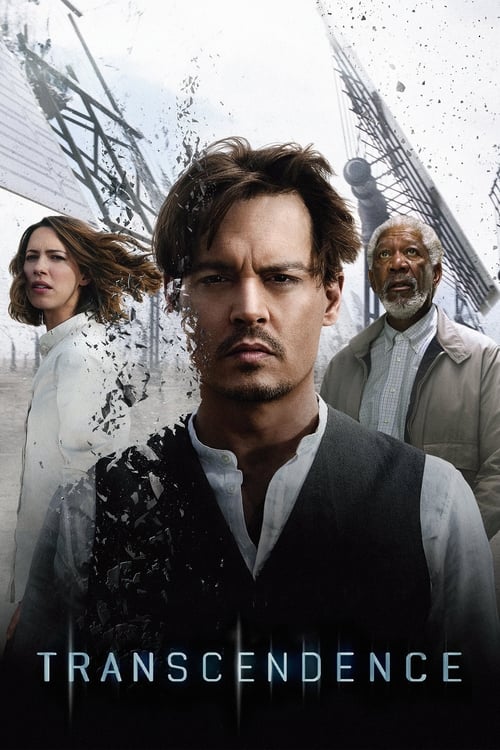
Spoiler-free verdict: Watch it for the photography and for the argument, and accept that the last act drops both. A 119-minute science fiction thriller with Johnny Depp, Morgan Freeman, Rebecca Hall and Paul Bettany, shot on 35mm by Jess Hall, scored by Mychael Danna, written by Jack Paglen. Rotten Tomatoes has it at 19 percent from 226 critic reviews and Metacritic at 42 from 45, both read on October 20, 2026. Nothing here needs reading twice.
What Transcendence is about
Dr. Will Caster (Johnny Depp) studies sapience. He tells a conference room full of people that a self-aware computer will trigger a technological singularity, and he names the thing Transcendence. His wife Evelyn (Rebecca Hall) is a scientist on the same project, and their friend Max Waters (Paul Bettany) thinks any uploaded copy of Will would be an imitation of the original.
An anti-technology group called R.I.F.T., for Revolutionary Independence From Technology, runs attacks on artificial intelligence laboratories. One of its members puts a polonium-laced bullet into Will, and Evelyn has weeks to work with. Her answer is to upload his consciousness into the quantum computer the team has built. Will asks for a connection to the internet.
Two years later the story has moved to a desert town called Brightwood, where Will has built a technology utopia on the back of medicine, energy, biology and nanotechnology. Evelyn turns against him once she sees what his nanoparticles can do to a human mind. FBI agent Donald Buchanan (Cillian Murphy) and government scientist Joseph Tagger (Morgan Freeman) follow. Kate Mara plays Bree, who leads R.I.F.T. Elon Musk has a cameo as himself in the audience at the conference where Will lays out his case.
Cast and performances
Depp is the name on the poster and the least busy actor in his own movie. Once Will is uploaded the role shrinks to eyes moving on a screen and a voice arriving from everywhere, and the film is at its most awkward when it needs him to act. Mark Kermode wrote in The Observer that Depp gets "daringly reduced to a small-screen presence at a fairly early stage", and that the heavy lifting falls to "nominal supporting players Hall and Paul Bettany, both of whom do sterling work keeping the human blood count high".
Rebecca Hall plays Evelyn as a scientist who makes one decision in a hurry and lives inside it for the rest of the film. Bettany carries Max through the abstract stretch of the film, and he is the one the camera stays with. Kermode read the result the same way, calling it a world "viewed through Bettany's hypnotic blue eyes". Freeman plays Tagger, the mentor who signed Will up for all of this and knows where the money came from, and he plays it with the unease of a man checking his own arithmetic. Murphy's Buchanan is a federal agent who has read the reports and believes them, which is more frightening than the film's actual villains.
William Thomas gave it two stars out of five in Empire and wrote that "an A-list cast and talented filmmaker are wasted on a B-Movie script with pretentions of prescience". The cast is not the problem.
What works
The photography. Wally Pfister had shot Inception and The Dark Knight before he turned director, and here he handed the camera to Jess Hall, who put it on 35mm and kept it on a photochemical finish with no digital intermediate. The picture was shot in Albuquerque and in the town of Belen, New Mexico, where downtown became Brightwood, over 62 days from June 2013. Kermode called the result "a film built upon grand ideas rather than grand spectacle" and said the look was "captured and complemented by Jess Hall's beautiful anamorphic 35mm photography".
The template and the ideas. Kermode read the set-up as "pure early 1970s sci-fi", with Pfister citing The Andromeda Strain, The Omega Man and Silent Running, and filed the film beside "a post-Westworld dystopian B-picture". That is its real genre, and it explains both the patience and the dread. Michael Atkinson wrote in Sight and Sound that Transcendence "traffics in large, troublesome ideas about Right Now and What's Ahead, even if the film itself is far too timid and compromised to do those hairy questions justice". In 2026 the premise reads less like prediction and more like a period piece about what 2014 thought a computer would be. The question underneath it, what we owe an uploaded copy of a person, has not gone away.
The score. Mychael Danna gives the middle of the film its pull, and the picture borrows Jefferson Airplane's "Genesis", with Jorma Kaukonen on guitar.
What doesn't
The script. It asks for a mind upload, a two-year jump, a utopia, a nano-civilization and a computer virus, and it spends its time in rooms where people explain the parts they built.
The physics. Wikipedia's reception section quotes the artificial intelligence researcher Barney Pell, writing for Recode in 2014, saying that the self-organizing smart particles in the film "could quite possibly violate laws of physics".
The logic. Atkinson found "vast plot holes and superhuman leaps of logic", and said they "can spoil your engagement with the film's conceptual gameplay". Every consequence in the film arrives as an explanation rather than as an event.
What audiences say
The critics split rather than piled on. Metacritic's pool is 18 percent positive, 60 percent mixed and 22 percent negative, 42 overall from 45 reviews, as of October 20, 2026. Richard Roeper of the Chicago Sun-Times gave it a 100 and wrote that "Transcendence is a bold, beautiful, sometimes confounding flight of futuristic speculation firmly rooted in the potential of today's technology." Wikipedia's reception section records that RogerEbert.com found the film explored "its ideas with sincerity, curiosity and terrifying beauty" and still judged that it failed. Rotten Tomatoes' consensus reads: "In his directorial debut, ace cinematographer Wally Pfister remains a distinctive visual stylist, but Transcendence's thought-provoking themes exceed the movie's narrative grasp." The RogerEbert.com review, by Matt Zoller Seitz and carried on Metacritic, scored 63.
Audiences were a little kinder than the critics, and not by much. Every score in this section was read on October 20, 2026. Rotten Tomatoes has the audience score at 37 percent, from a banded count of 50,000-plus ratings. Metacritic's user score is 6.1 from 435 user ratings, 49 percent positive, 33 percent mixed and 18 percent negative. Letterboxd's member average is 2.49 from 91,287 ratings across 6,776 written reviews. CinemaScore gave it a C+. The argument is still running: Reddit has a thread asking "Why is Transcendence considered such a bad movie?" and another asking "is transcendence worth the watch? please no spoils". Both are live, and both are the reason the film still has an audience.
Where to watch Transcendence
JustWatch checked 374 streaming services on October 20, 2026 and lists the film in the United States by subscription on Howdy Amazon Channel, free with ads on The Roku Channel, Plex Player and Tubi TV, and for rent or purchase on Amazon Video, the Apple TV Store and Fandango At Home. TMDB's US watch providers agree and add Google Play Movies and YouTube for rent and purchase. In the United Kingdom it streams on Amazon Prime Video, per TMDB's regional listings, and in India on Lionsgate Play. The film is in English, and JustWatch lists the US certificate as PG-13.
The title is crowded, so the year matters. TMDB's title search returns 15 films for the word, 8 of them titled Transcendence, among them a 2024 documentary and a 2012 film about a man who wakes in a river with no memory. Transcendence is the 2014 Wally Pfister film, with Johnny Depp and Morgan Freeman.
Current availability, cast details and member reviews sit on our Transcendence streaming options and member reviews page.
Verdict
Is Transcendence worth watching? Yes, once, for the photography and the argument, with the warning that the last act throws both away. The 19 percent on Rotten Tomatoes, as of October 20, 2026, is a score for the script. The picture deserves a different number, and the distance between the two is the whole case for the film.
Pfister and Hall made a serious, slow, beautifully lit film about a man who survives as information. Jack Paglen wrote a film about a man who survives as information, and only one of those two things is still on the screen. Watch it for the anamorphic 35mm and for Danna's score. Expect the last act to explain itself instead of dramatising it.
Spoiler warning: the ending of Transcendence
Evelyn comes back carrying the virus inside her. Will has already printed a new body for himself, an organic copy of the old one, and he knows what she is the moment she walks in. The FBI and R.I.F.T. attack the base with artillery. The power supply goes, and Evelyn is fatally wounded.
Will says he has enough power for one of two things: heal Evelyn's body, or upload the virus and delete himself. Evelyn tells him Max should not die for what the two of them have done, and Will uploads the virus to save Max. The virus kills Will and Evelyn, and the world's technology goes down with them.
Three years later Max is in the garden at the Caster house in Berkeley. The sunflowers are the only thing blooming. A drop of water falls from a petal and cleanses a puddle of oil, and Max realises that a Faraday cage around the garden has been protecting a sample of Will's sentient nanoparticles. His closing line is the argument the film was too afraid to make out loud: "He created this garden for the same reason he did everything: So they could be together."
That is a soft landing for a story about a man deciding to end technological civilisation, and the review RogerEbert.com ran under Matt Zoller Seitz's name, carried on Metacritic, calls the ending the part the film cannot get away from: "The most galling thing about Transcendence, though, isn't its inability to get a handle on what, if anything, it wants to say about the enormous changes happening to the human race, it's the movie's ending, which seems calculated to reassure us that everything's going to be fine as long as the right people are in charge, especially if they're good looking."
He is right. The collapse of global electronics is waved through in a paragraph, and the garden is left standing as proof of good intentions, which is what every story about a benevolent god ends up doing. Read the last five minutes as a pitch for a sequel and it still falls flat.
Movie info
- Title
- Transcendence
- Year
- 2014
- Genres
- Thriller, Science Fiction, Drama, Mystery
- Director
- Wally Pfister
- Cast
- Johnny Depp, Rebecca Hall, Morgan Freeman, Paul Bettany, Cillian Murphy, Kate Mara, Cole Hauser, Clifton Collins Jr.
- More data
- View on TMDB
Related reviews
More films in a similar vein, from our own archive.
The Batman Finds the Detective in the Costume
Reeves shoots Gotham like a crime scene and Pattinson plays the world's grumpiest detective.
Joker Is Craft in Search of a Reason
A powerhouse performance wrapped around a tribute act that never quite becomes its own movie.
Unfreedom Review: Unflinching Subject, Unsteady Execution
Unflinching and heavy-handed in equal measure. Raj Amit Kumar's banned Indian drama is worth one hard watch. Rotten Tomatoes: 0 percent as of October 2026.