
Toy Story 5 Review: Jessie Takes the Lead and the Franchise Finally Grows Up
Andrew Stanton hands Toy Story 5 to Joan Cusack's Jessie and makes a tablet the villain. The craft is immaculate and the script repeats itself. Our verdict.
Toy Story 5 (2026)
My review
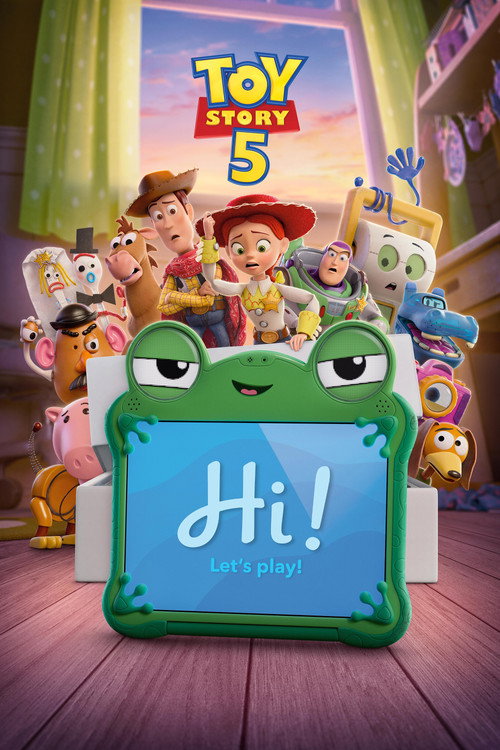
See Toy Story 5, and take the children. Andrew Stanton has handed the franchise to Joan Cusack's Jessie, made the enemy a frog-shaped tablet, and built a 102-minute argument for going outside and playing. The animation is immaculate and the theme is the right one for 2026. The script repeats itself, the adults are written small, and the sharpest review of it says the picture is dead at heart.
Spoiler-free verdict: Worth it, especially for a family. A 102-minute Pixar comedy that gives the franchise a new lead in Jessie and a subject it has never had, screen time versus play. Rotten Tomatoes has it at 92 percent from 331 critic reviews. You need no plot summary before pressing play.
What Toy Story 5 is about
Bonnie is eight and she still plays with toys, which in 2026 makes her the odd one out. The other kids have screens, so the other kids have friends, so Bonnie does not, and her parents buy her a frog-shaped tablet called Lilypad, voiced by Greta Lee, to solve the problem. Lily works. Bonnie has playdates within fifteen minutes. She also has a group chat in which the other children ridicule her for still clinging to her old toys, and that is the trap the whole film is built on.
Jessie (Joan Cusack) has been here before. She was Emily's toy, and Emily grew up and left her, and Jessie has carried that since Toy Story 2. Bonnie is her new owner, and Bonnie is the one child who might play with her. So Jessie decides the tablet is the problem and starts a campaign to get Bonnie back to being a child who plays. The complication is that Lily can also be right: a friend you make through a screen is a different kind of friend from a friend you share a space with.
The rest of the gang is there. Woody (Tom Hanks) is living with Bo Peep and other abandoned toys away from the children, balding and heavier. Buzz (Tim Allen) is in love with Jessie and too shy to propose. And a container of hi-tech Buzz Lightyears has washed up on a desert island in demo mode, and they are following the North Star back to Star Command, which is very funny for a while and then joins the plot.
The first Toy Story film since Toy Story 4 (2019), and the first main entry without John Lasseter, who left Pixar in 2018. Randy Newman scores it, the tenth Pixar feature on his filmography, and Taylor Swift contributes the single "I Knew It, I Knew You".
Cast and performances
Joan Cusack is the best thing in the film and the reason it is worth making. Jessie was a supporting player for twenty-seven years and she plays the lead as a cowgirl with a broken record and a job to do. Owen Gleiberman at Variety noticed the voice work and wrote that it "makes Jessie a gruffly infectious good ol' girl". Robert Daniels at RogerEbert.com saw the choice of lead as the film's argument, and put the reason plainly: Jessie is the cowgirl who came into the fold after enduring a heartbreaking abandonment decades ago, and the re-centering "interrogates the importance of play in a digital world".
Tim Allen's Buzz is doing something the character has never done, which is being nervous. Daniels noted the effect, and called it the film subverting gender expectations by making Buzz bashful. Tom Hanks's Woody is charming, and this film does less with him. Mykal-Michelle Harris plays Blaze, the farm girl who is Bonnie's answer, and Greta Lee plays Lily with a cheerfulness that makes the film's argument harder than it should be.
What works
The animation, obviously. The paint, the fabric, the way the toys hold light, the high-comedy sequences of spangly fluorescent color where Gleiberman says the action is hilariously straight from a child's brain. The Buzz Lightyear unit on its island is a Pixar sequence doing something Pixar sequences are good at, a handful of identical toys behaving like a crowd.
The subject. Gleiberman named it: "a new theme emerges that's hauntingly and movingly of its time: the disappearance of play." It is the first Toy Story film with a subject that belongs to the decade it was made in rather than to the era it grew out of, and Damon Wise at Deadline saw the same reach, writing that the film caters for younger audiences by emphasizing the need for a lower-fi me-time childhood while also addressing far more adult concerns.
The second half of the Jessie story. Daniels found two sequences that clear the bar of the Toy Story 3 incinerator scene, and Jessie at Emily's old farm is where the film's oldest wound gets touched rather than retold.
The new toys. Smarty Pants the toilet trainer (Conan O'Brien), Snappy the camera (Shelby Rabara) and Atlas the GPS hippo (Craig Robinson) are obsolete devices on the wrong side of a generational gap, and they are funny, and Bradshaw at The Guardian was right that their job in the story is to introduce the idea that tech maybe isn't all bad.
The family framing, which is half right. Damon Wise at Deadline called it "the biggest family movie of the year", and that is true about the surface. Bradshaw, writing the same week, described "the unblemished sheen of a brand new smartphone. But at heart, it has gone dead." The two reviews are about the same film. The family label covers the first sentence and not the second.
What doesn't
The script, which repeats itself. The first half of the film sets up the tablet problem, the sleepover, the group chat, the toys being thrown in storage, and the farmhouse. The second half re-sets up the tablet problem in a bigger way. The plot moves in circles and lands where it started, and the movie spends its best asset, Jessie, on the detour.
The safe handling. Daniels was blunt about it: "In that sense, this film doesn't take many risks: it's your prototypically beautifully rendered movie tackling a heady subject in the safest possible manner." Wise at Deadline disagreed about how safe it is, and that disagreement is the interesting one. One review sees a picture for parents and grandparents, the other sees a picture for children.
The big idea, abandoned. Bradshaw's complaint is the sharpest one in the file. The film "even calamitously loses its nerve with its own big idea", and the theme the whole franchise is built on, a toy outliving the child who loved it, "feels underpowered" in a picture that spends most of its running time on a tablet. For a film about what happens when a child grows up, the grief is doing very little work.
The adults. The most reliable criticism of the film is that the grown-ups are written small. Daniels pointed at Woody, and noted that the running bits which poke fun at his weight gain and his shiny bald spot stay as jokes and never ladder into anything more existential. Bradshaw agreed about the franchise generally, writing that intellectual-property exhaustion has set in.
What audiences say
All figures checked on October 21, 2026. Rotten Tomatoes has the film at 92 percent from 331 critic reviews, with a 94 percent Popcornmeter from more than 10,000 verified ratings, and its critics consensus reads: "Proving that old toys can learn new tricks while reckoning with an era of endless screen time, Toy Story 5 largely sidesteps franchise fatigue by reaffirming that children everywhere still got a friend in these lovable characters." Metacritic has a Metascore of 73 from 55 critic reviews, labelled Generally Favorable, plus a user score of 7.0 from 365 user ratings. IMDb has it at 7.3 out of 10 from 102,000 ratings. Letterboxd's member average is a weighted 3.62 from 1,239,659 ratings, with 515,210 written reviews. TMDB has it at 8.3 from 2,674 votes.
Metacritic's 73 from 55 critic reviews sits below the Rotten Tomatoes and IMDb figures, and Letterboxd's 3.62 is the same temperature in audience form. A 3.62 on the five-point scale, from more than 1.2 million voters, is a good crowd's verdict on a film nearly everyone went to. It is a good film that a large number of people watched and found pleasant, which is a different thing from the picture the reviews describe.
Box Office Mojo's figures, read on October 21, 2026, put the film at $480,294,461 domestic and $1,148,881,610 worldwide, from a United States release on June 19, 2026 that opened with $159,677,837. Wikipedia's summary of the same records gives a $250 million budget and calls it the third-highest-grossing film of 2026, the highest-grossing in the franchise, the tenth-highest-grossing animated film ever, and the biggest worldwide opening weekend in Pixar's history.
Where to watch Toy Story 5
It is on Disney Plus, which is a subscription service, and JustWatch, which checked 376 streaming services on October 21, 2026, confirms it. The same check lists rental and purchase on Amazon Video, the Apple TV Store and Fandango At Home, and a DVD and Blu-ray from Amazon DVD / Blu-ray and Barnes & Noble. TMDB's United States watch providers agree. The certificate is PG. The run time is 102 minutes, which Deadline and Metacritic both list as 1 hour 42 minutes.
Current availability, cast details and member reviews sit on our Toy Story 5 streaming options and member reviews page.
Verdict
Is Toy Story 5 worth watching? Yes, and for the reason you would expect, which is that the animation is still the best in the business and the new idea, a tablet as the antagonist, is the right idea for the year it arrived in. Jessie is a proper lead, and Cusack plays her with a broken heart and a job to do. What holds the film back is that it does not trust the idea enough, and that the writing treats grief and the grown-ups as furniture. This is a good 102 minutes, and it is good because the animation carries it and the theme is right, not because the script is brave. That the latest Toy Story is still this watchable is not a small thing.
Spoiler warning: the ending of Toy Story 5
Jessie sulks under a tree at Emily's old farm, and digs up a time capsule of late-twentieth-century objects with photographs of adult Emily and her daughter, who was named after Jessie. She learns that she still mattered to Emily long after she was given away, and her faith in Bonnie comes back. The argument the franchise has been built on since Toy Story 2, that a toy can matter to a child who has outgrown it, lands here, and only here.
Meanwhile the Buzz units, still in demo mode after washing up on the island, capture Woody because they suspect he means Jessie harm, until Buzz explains what is really going on. Lily, who has realised what she did to Bonnie, has hidden from the group by boarding a donation truck. The toys catch up with the truck and talk her into going back and helping Bonnie meet Blaze.
Bonnie and Blaze are put in a room together. Bonnie is shy about the toys at first, then the two girls find each other through the things they both love, and they play. The toys put on a pretend wedding for Jessie and Buzz, and Woody watches it happily before he leaves with Bo Peep and the other lost toys. The Buzz units are taken in by different children at a school playground. Jessie and Buzz kiss, finally.
Damon Wise at Deadline reported a post-credits sting that teases the return of Emperor Zurg.
Movie info
- Title
- Toy Story 5
- Year
- 2026
- Genres
- Animation, Family, Comedy, Adventure
- Director
- Andrew Stanton
- Cast
- Joan Cusack, Tom Hanks, Tim Allen, Conan O'Brien, Scarlett Spears, Greta Lee, Shelby Rabara, Mykal-Michelle Harris, Craig Robinson, Jay Hernandez
- More data
- View on TMDB
Related reviews
More films in a similar vein, from our own archive.
Fire and Ice (1983) Review: The Cult Animation That Still Looks Like a Painting
Bakshi's rotoscoped 1983 fantasy still looks like a Frazetta painting. The art endures, the script loops, the 2026 4K UHD release gives it a second run.
Matchbox the Movie Review: Great Stunts, Thin Script, Blatant Toy Sale
24 percent Tomatometer, fun stunts, thin script. Our Matchbox the Movie review: where to watch on Apple TV+, and the stream or skip verdict.
Avengers: Endgame Review: A Near-Perfect Goodbye Back for the 2026 Encore
Back in cinemas as the 2026 Encore edition. Rotten Tomatoes has the 2019 film at 94 percent from 553 critic reviews. Where to watch, and our verdict.


