Street Fighter Review: Faithful to the Games, Lost in Its Own Plot
The fights land and the cast knows the games, but the script runs four plotlines at once and 42% on Rotten Tomatoes is not a typo. Our Street Fighter review.
Street Fighter (2026)
My review
Street Fighter is worth watching for the fights, and for not much else. Kitao Sakurai's adaptation of the Capcom games opened in US theaters through Paramount on October 16, 2026, and it hands you 120 minutes of game-accurate moves, fully animated interludes, and a cast of people who plainly grew up on the arcade cabinet. The story is where it falls apart. Four plotlines share the same running time, most of the tournament happens off screen, and the screenplay never finds a shape for the thing it is about. Critics noticed. Rotten Tomatoes has it at 42 percent from 120 reviews and Metacritic sits at 44 from 26 critic reviews, both checked on October 21, 2026.
The Numbers, checked on October 21, 2026, has the film at $32,666,830 domestic and $52,766,830 worldwide against an $82 million production budget, with $30,775,377 of that domestic total arriving in the opening weekend from 3,575 theatres. The certificate in the US is PG-13, and the runtime is two hours with no credit.
Spoiler-free verdict: Watch it if you want the games filmed properly and can forgive a plot with no pulse. A 120-minute, PG-13 action film with Ken, Chun-Li, Blanka and a cast stacked with wrestling and kickboxing names. Rotten Tomatoes says 42 percent from 120 critic reviews as of October 21, 2026, and Metacritic says 44. You need no plot summary before pressing play.
What Street Fighter is about
The story opens in 1987, in a fully animated anime prologue, at the first World Warrior tournament. Ryu beats Sagat with the Dark Hadou, the demon Akuma notices, and Ryu is left with two problems: his master Gouken, whose death comes soon after the fight, and an adoptive brother, Ken Masters, who blames him for the rift. Ryu disappears into a life of handing out ramen on the street. Ken becomes a celebrity, a show fighter doing commercials for colas and batteries.
Six years later, in 1993, the dictator M. Bison stages the second World Warrior tournament in Metrolao City. Chun-Li, an undercover Interpol agent working on her father's murder, recruits both men. Ryu only enters because Akuma has threatened to kill whoever wins, and he wants Ken out of the bracket. Bison's real plan is a device that pulls the fighting power out of a champion, which is what Chun-Li is trying to stop. Ryu's own story, the one about the tournament and the demon, gets pushed to the side while Bison's machine and the family argument take up the middle.
Street Fighter cast and performances
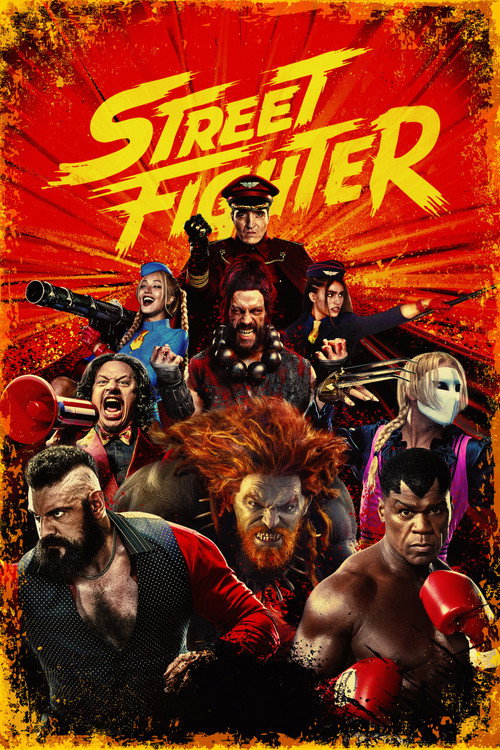
Noah Centineo plays Ken as a golden boy who has been coasting on his name, and he lands it. The A.V. Club's Jacob Oller noticed the way the film leans on Centineo, and RogerEbert's Clint Worthington found a "Kurt Russell in Big Trouble in Little China" quality in the himbo register. Callina Liang's Chun-Li is the best thing in the film: a burnt-out Interpol agent who lies well and does not have time for the other fighters' jokes.
David Dastmalchian plays M. Bison with a curled sneer, and Jason Momoa turns up as Blanka in what is close to a cameo, a green monster with a few surprises in the performance. Cody Rhodes gives Guile an absurdly tall flat top and some of the movie's better comic lines, Orville Peck wears a mask as Vega because his stage persona already wears one, and 50 Cent plays the boxer Balrog, which is a joke that pays off in the ring. Joe Anoa'i, better known as Roman Reigns, plays Akuma. Andrew Schulz, who plays Ken's pal Dan Hibiki, takes a surprising amount of screen for a character with nothing to do.
What works
The fights, and the look of them. Cinematographer Ken Seng shoots the film through artificial grain and 1980s neon, and the choreography uses the game's special moves with vocal callouts, so a Hadouken reads as a Hadouken. The fully animated sequences are the part worth seeing. The A.V. Club's Oller called them "by far the best-looking, best-sounding, most coherent moments of the movie," and the reason holds up, because the live action keeps dumping the emotion on them.
Helen O'Hara in Empire thought the joke was on the moviegoer. Her verdict was that after the failed 1994 adaptation and the recent Mortal Kombat films, "the sucker-punch is that it's actually quite fun." The film knows a fight game is a comedy with rules, and it plays those rules straight for long enough to land.
What doesn't
The script has too many fighters and not enough room. Ryu is jailed for a large stretch of the runtime, which leaves Andrew Koji stranded as the film's earnest face in a movie full of loud ones, and the tournament that the whole story is built around keeps getting skipped. The A.V. Club's Oller called the result a film that "merely pratfalls for two excruciating hours of bad jokes, worse combat, and a plot that crumbles under the weight of its character select screen." RogerEbert's Worthington put it another way: "the punishing two-hour runtime ends in a flagrant call for a sequel, making the whole affair feel even more unfinished than it already was."
The cut is relentless. The film moves between Ken and Ryu's estrangement, Chun-Li's revenge plot, Bison's machine, and Dan's insecurity at a speed that leaves nothing landing, and the jokes get undercut by the next cut. Empire's O'Hara was the kindest of the critics on record and still found "far too much plot," a "nearly unforgivable sequel-baiting ending," and a 4 Non Blondes song playing over the 1987 scenes, since the band did not release it until 1993. RogerEbert's Worthington heard the same mismatch in the needle-drops and asked why "What's Up" was playing in the '80s and what "Who Let the Dogs Out," a 2000 track, was doing in the mix.
What audiences say
The split is the story here. Rotten Tomatoes has the Tomatometer at 42 percent from 120 reviews and the Popcornmeter at 79 percent from more than 1,000 verified ratings, a thirty-seven point gap between the two. Rotten Tomatoes' critics consensus says the film "has plenty of affection for its source material and doesn't lack for dizzying style, but its incoherent storytelling and juvenile humor make for a disappointing regression among video game adaptations."
Metacritic's user score is 6.8 from 174 ratings. Letterboxd is the outlier on the other side, with a member average of 2.81 from 103,183 ratings and 55,024 written reviews. TMDB has the film at 6.3 from 122 votes. Every figure in this section was checked on October 21, 2026.
Where to watch Street Fighter
Street Fighter is still in US cinemas. JustWatch checked 376 streaming services on October 21, 2026 and lists no subscription service for it in the United States, and no free option anywhere. The way in is a purchase: Fandango At Home sells the digital release for $24.99, which TMDB's own US provider list agrees with, and Amazon DVD / Blu-ray carries the disc. Tickets are on sale through Atom Tickets, Cinemark, Cinepolis Cinemas, Harkins Theatres, B&B Theatres and Marcus Theatres.
Current availability, cast details and member reviews sit on our Street Fighter streaming options and member reviews page.
Verdict
Is Street Fighter worth watching? If you are a fighting game fan and you can sit through a plot that never quite arrives, yes, and the fights reward you for the wait. If you need the story to hold together, no. Rotten Tomatoes' consensus calls it a disappointing regression among video game adaptations, and the 2.81 on Letterboxd says the fans who did turn up mostly felt the same. The 79 percent from verified audience viewers is the counterweight, and it is a heavy one. Take the fights, leave the plot.
Spoiler warning: the ending of Street Fighter
Ryu and Ken finally fight each other for real, and the thing that has been underneath the whole film comes out: Ryu resented Ken's optimism all along and destroyed his invitation to the first tournament out of jealousy. Ryu wins with a Hadouken. At the tournament, the kickboxer Joe is declared champion when Ken fails to appear, and Akuma arrives to collect, killing him before he can turn to Ryu. Overwhelmed, Ryu transforms into Dark Ryu and beats Akuma anyway. Ken, Chun-Li and Dan cannot stop him, so Ken throws his first Flaming Hadouken and brings Ryu back.
Bison walks away with Akuma's body and the power he pulled from Ryu. Cammy's troops destroy Chun-Li's van with a rocket launcher, so the heroes cannot follow. The next morning Ryu, Ken, Chun-Li and Dan leave Shadaloo on foot and get a ride from Guile and Dhalsim, agreeing to go after Bison together. The film ends there, with the villain intact.
Then the post-credits scene. On a beach or in jungle, a scarred man with an eyepatch and a gash across his chest is visited by Bison and his lieutenants. That is Sagat, the man Ryu beat in the 1987 prologue, and he is standing with the enemy now.
Movie info
- Title
- Street Fighter
- Year
- 2026
- Genres
- Action, Fantasy
- Director
- Kitao Sakurai
- Cast
- Andrew Koji, Noah Centineo, Callina Liang, David Dastmalchian, Jason Momoa, Cody Rhodes, Mel Jarnson, Vidyut Jammwal, Andrew Schulz, 50 Cent
- More data
- View on TMDB
Related reviews
More films in a similar vein, from our own archive.
The Odyssey Review: A Vast Epic That Never Quite Breaks Your Heart
Nolan's Greek epic is vast and strangely cold. Rotten Tomatoes has it at 94 percent from 515 critic reviews. Where to watch, and our verdict.
Jupiter Ascending Review: Gorgeous Effects, Broken Story
Watch it for the design, skip it for the script. The Wachowskis' space opera is gorgeous and hollow. Rotten Tomatoes has it at 27 percent as of October 2026.
Avengers: Endgame Review: A Near-Perfect Goodbye Back for the 2026 Encore
Back in cinemas as the 2026 Encore edition. Rotten Tomatoes has the 2019 film at 94 percent from 553 critic reviews. Where to watch, and our verdict.